
Occupational Therapy for the Elderly: What It Is and How It Helps the Family
Discover how the occupational therapist helps seniors regain their independence in daily activities and what families can do at home to support their recovery.
Contents
When your mother can no longer do up her own blouse buttons, or your father avoids the kitchen because he's afraid of dropping a pot, you realise something has changed. Perhaps after a stroke, perhaps due to Parkinson's disease, or simply because the years have taken their toll on hands that once did everything with such ease. In these moments, families look for solutions – and often discover that recovery means not only physical exercises, but also relearning the simple movements that make up daily life.
This is where the occupational therapist comes in – a specialist less well known in Romania, but essential to the quality of life of older adults. Unlike physiotherapy, which focuses on movement and muscle strength, occupational therapy targets independence in concrete everyday activities: getting dressed, cooking, personal hygiene, and even hobbies. It is about living, not merely moving. And, just as importantly, it is about helping loved ones remain themselves, even when their body no longer cooperates quite so well.
This article is aimed at families who are discovering occupational therapy for the first time, or who want to understand how they can support the therapist's work at home. We will explore what it involves in practice, when it is recommended, and how you can find these services in Romania.
Contents
- What occupational therapy is and how it differs from other forms of rehabilitation
- Practical activities in occupational therapy
- Which conditions it is recommended for
- Adapting the home and recovering independence
- How the family can support exercises at home
- Where to find occupational therapy services in Romania
- Frequently asked questions
What occupational therapy is and how it differs from other forms of rehabilitation
Occupational therapy is a medical speciality that helps people of all ages regain or maintain their independence in meaningful daily activities. For older adults, this means being able to do on their own the things that give their life meaning: getting dressed in the morning, making their favourite cup of coffee, reading the newspaper, or tending to their plants.
Many people confuse occupational therapy with physiotherapy or kinesitherapy, but the differences are significant. Physiotherapy focuses on recovering motor functions – strength, balance, and range of motion. The occupational therapist uses these functions for a concrete purpose: if physiotherapy teaches you to move your arm again, occupational therapy teaches you to use that arm to comb your hair, eat, or write.
The occupational therapist's holistic approach
What makes occupational therapy unique is that it views the person as a whole – not just the medical condition. The therapist assesses the environment in which the older adult lives, their social relationships, the hobbies they have had, and even the furniture in the home. They then create a personalised plan that combines specific exercises with practical adaptations and compensatory strategies.
Key differences from other forms of rehabilitation:
- Focus on independence in activities that are meaningful to the individual, not merely on muscle function
- Environmental adaptation and the use of assistive devices to compensate for limitations
- Cognitive training alongside physical training – memory, attention, and planning
- Resuming social roles – grandparent, host, gardener, hobbyist
- Prevention of complications through maintaining activity and mental stimulation
Practical activities in occupational therapy
When you first hear about occupational therapy, you probably wonder: what does the therapist actually do with your mother or father? The answer is both simple and complex – they work with the activities of daily life, but in a structured, progressive manner tailored to individual needs.
Self-care activities
These are fundamental to dignity and independence. The occupational therapist systematically addresses every aspect of personal care:
- Dressing and undressing – specialist techniques for people with reduced mobility, using button hooks, long-handled shoe horns
- Personal hygiene – tooth brushing with handle adaptors, combing with specially designed brushes, shaving safely
- Bathing and showering – transferring into the bath or shower cubicle, using a shower chair, washing aids
- Toileting – raised toilet seats, grab rails, safe transfer techniques
- Eating – adapted cutlery for tremor or weakness, one-handed cutting techniques
Instrumental activities – independent living
Beyond self-care, the therapist works on more complex activities that allow the older adult to live independently or semi-independently:
- Cooking – preparing simple meals safely, using adapted cookers, vegetable-cutting techniques
- Housekeeping – lightweight brooms and hoovers, organising the space for easy access
- Managing medication – organisation systems, alarms, dosette boxes
- Handling finances – cognitive strategies for those with memory difficulties
- Using the telephone and technology – adaptations for hearing loss or poor vision
Leisure and socialisation activities
Quality of life is not only about functionality – it is also about enjoyment. The occupational therapist gradually reintroduces hobbies and interests:
- Adapted manual activities – knitting with thicker needles, painting with specialist brushes, gardening with ergonomic tools
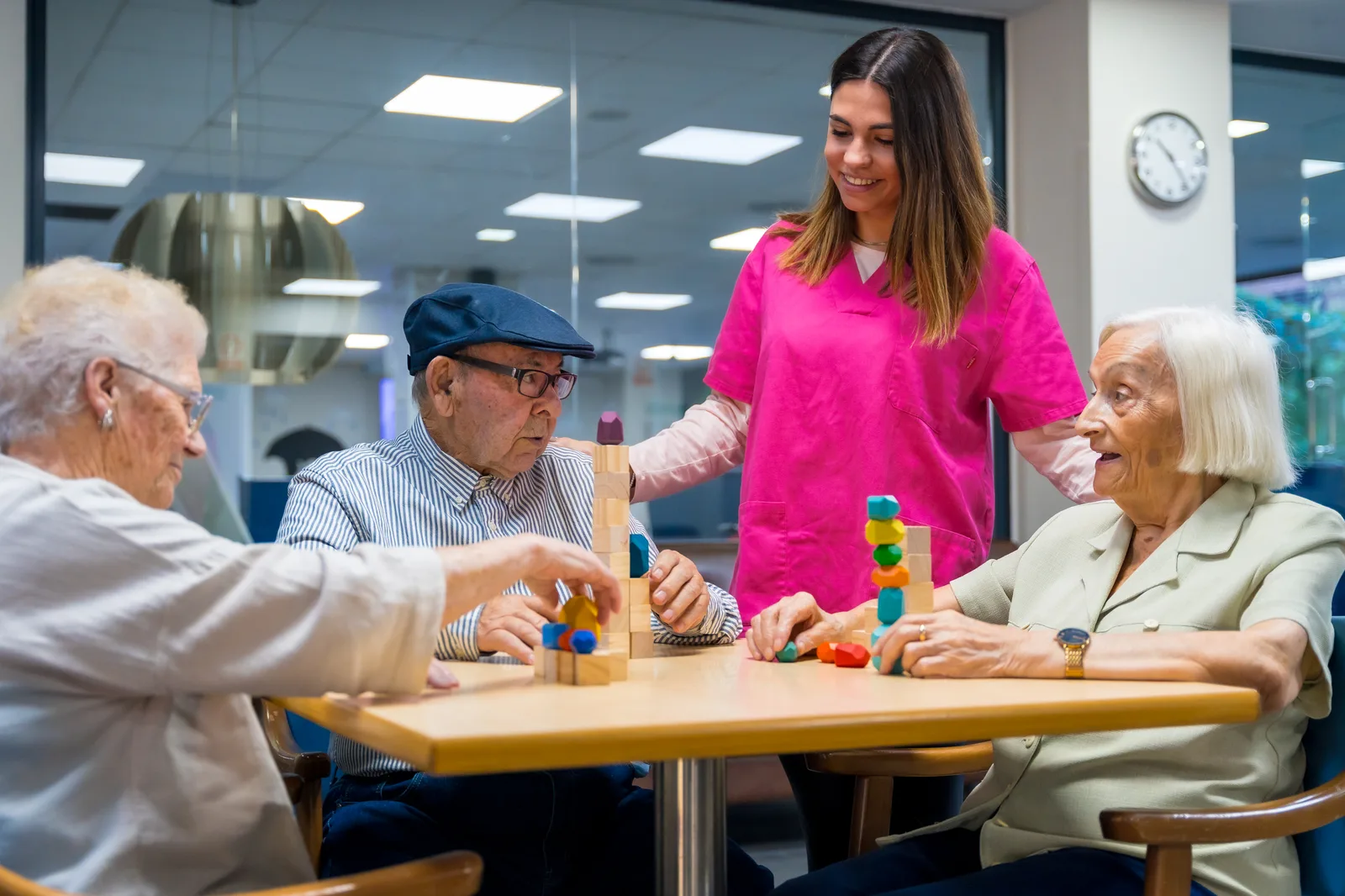
- Cognitive games – jigsaws, card games, tablet applications
- Reading and writing – magnifying glasses, book stands, pens with special grips
- Social activities – strategies for maintaining contact with friends and family
Which conditions it is recommended for
Occupational therapy is recommended in most situations where a medical condition affects a person's ability to carry out everyday activities. For older adults, several situations are particularly common and benefit especially from this approach.
Stroke
Perhaps the most common indication for occupational therapy in older adults, stroke frequently leaves lasting effects that directly impact independence – partial paralysis, coordination difficulties, cognitive or speech impairments. The occupational therapist intervenes from the time the patient is still in hospital and continues rehabilitation for months, teaching the patient to compensate for lost functions and gradually regain independence in simple, then more complex, activities.
Post-stroke rehabilitation with occupational therapy includes:
- Retraining functions of the paralysed or weakened hand
- One-handed dressing techniques
- Cognitive strategies for spatial neglect (when the patient ignores one half of their visual field)
- Home adaptation to prevent falls and improve accessibility
Parkinson's disease
The tremor, rigidity, and slowness of movement characteristic of Parkinson's disease make fine motor tasks particularly difficult. The occupational therapist provides concrete strategies to maintain independence for as long as possible, adapting techniques as the disease progresses.
Dementia and Alzheimer's disease
In dementia, occupational therapy does not aim to cure, but to maintain functioning and quality of life for as long as possible. The therapist works with both the patient and the family, providing structured routines, cognitive activities adapted to the person's current level, and home safety strategies. The goal is to keep the person active and engaged in life, reducing agitation and apathy.
Hip fractures and other orthopaedic problems
Hip fractures are particularly problematic in older adults, carrying the risk of immobility and loss of independence. After surgery, occupational therapy complements physiotherapy by teaching the patient to move safely around the home, to get in and out of the bathroom, to climb stairs, and to use crutches or a walking frame in practical everyday situations.
Arthritis and chronic pain
For older adults with severe arthritis, even opening a jar becomes a challenge. The occupational therapist provides assistive devices, joint protection techniques, and energy conservation strategies to maintain independence without worsening pain.
Adapting the home and recovering independence
One of the occupational therapist's most valuable contributions is assessing and adapting the living environment. Many falls and accidents involving older adults occur at home, in a space that no longer matches their current capabilities. The therapist brings a specialist eye that identifies hazards and proposes practical solutions, which are often simple and affordable.
A home visit assessment – how it works
An experienced occupational therapist can carry out a visit to the older adult's home, assessing each room in light of their specific needs. They observe how the person moves around, what obstacles they encounter, which activities they avoid because of the layout, and what risks are present. They then discuss their findings with the family and propose priority adaptations, taking the available budget into account.
Common adaptations in different areas of the home:
- Bathroom – grab rails next to the toilet and bath, non-slip mat, shower chair, raised toilet seat
- Bedroom – bed height adjusted for easy transfers, bedside table within reach, night light
- Kitchen – utensils organised at an accessible height, stool for sitting whilst cooking, visual markings on the hob for those with dementia
- Hallways and stairs – removal of slipping rugs, adequate lighting, handrails on both sides of the stairs
- Living room – armchairs at an appropriate height with firm arms, removal of low furniture, hidden cables
Assistive and compensatory devices
The occupational therapist is familiar with a wide range of assistive devices that can make the difference between dependence and independence. Some are simple and inexpensive, others more sophisticated, but all are chosen according to the individual's needs and their ability to use them effectively.
How the family can support exercises at home
Sessions with the occupational therapist are essential, but they usually take place for only a few hours per week. For the rest of the time, the family plays a crucial role in maintaining progress and integrating the techniques learnt into the daily routine. Your support makes the difference between sustained recovery and regression.
Core principles for supporting at home
The first and most important principle is to encourage independence, not dependence. It is tempting to do everything for your parent when you see them struggling – doing up their buttons, cutting their food, bringing things within reach. But the occupational therapist works in exactly the opposite way: they encourage the person to do as much as possible on their own, even if it takes longer and is not done perfectly.
A few golden rules for families:
- Patience and extra time – allow the older adult to complete the task at their own pace, without rushing
- Positive encouragement – highlight progress, not failures; "Today you managed to do up three buttons on your own!" rather than "You still can't do it by yourself..."
- Structure and routine – a predictable daily schedule reduces anxiety and makes learning easier
- Safety without overprotection – eliminate major risks, but allow the person to take controlled risks
- Communication with the therapist – report progress and difficulties, and ask for clarification when you don't understand an exercise
Exercises and activities to continue at home
The therapist will give you specific guidance, but in general, any activity that is meaningful to the older adult can be turned into therapy. If your mother enjoyed cooking, involve her in meal preparation – even if she only washes the salad or stirs something in a bowl. If your father was passionate about gardening, you can adapt the activity using raised pots at an accessible height and lightweight tools.
Therapeutic activities integrated into the daily routine:
- Folding laundry – excellent for coordination and fine motor skills
- Sorting buttons or coins – cognitive training and dexterity
- Preparing a shopping list – memory, planning, writing
- Caring for a plant – responsibility, routine, satisfaction
- Simple board games – social interaction and cognitive stimulation
When to help and when to let the person manage on their own
This is the question families face every day. A useful guideline: help when there is a real risk of injury, or when frustration becomes so great that the person gives up entirely. Otherwise, offer time, encouragement, and minimal assistance – "What can I do to help you?" rather than taking over the task completely.
Where to find occupational therapy services in Romania
Although occupational therapy is less well known in Romania compared to other European countries, services do exist and are gradually developing. The challenge for families is often finding them and understanding what reimbursement options are available to them.
Private occupational therapy practices
In larger cities – București, Cluj-Napoca, Timișoara, Brașov, Iași – there are private practices where certified occupational therapists work. These typically offer comprehensive assessments and personalised programmes, including home visits. Costs vary considerably, at around 150–300 RON per session, depending on the therapist's experience and the complexity of the intervention.
Rehabilitation centres and geriatric clinics
Many neuromotor rehabilitation centres or clinics specialising in geriatrics include occupational therapy in their service packages. The advantage is the multidisciplinary approach – the occupational therapist works alongside physiotherapists, doctors, and speech and language therapists to deliver a comprehensive rehabilitation programme.
Care homes and day centres
Some private care homes for older adults and day centres have begun integrating occupational therapists into their teams. These therapists work with residents to maintain independence and deliver stimulating group activities. If you are considering a care home for your loved one, ask specifically whether they have an occupational therapist on their staff.
DGASPC and social services
The General Directorates for Social Assistance and Child Protection (DGASPC) in some counties offer occupational therapy services for older adults in need, either free of charge or at subsidised rates. Information varies from county to county – it is worth contacting your local DGASPC or town hall to find out which programmes are available in your area.
Reimbursement through the Health Insurance Fund
The good news is that occupational therapy can be partially reimbursed through the National Health Insurance Fund (CNAS), though access is still limited and the administrative procedures can be complex. Your GP or specialist (neurologist, geriatrician) can issue a referral to practices that have contracts with the insurance fund.
Steps to access reimbursed services:
- Speak with your GP about the need for occupational therapy
- Obtain a referral to a provider contracted with CNAS
- Check the list of providers in your county on the health insurance fund's website
- Make an appointment and bring complete medical documentation
- Follow the programme recommended by the therapist, documenting progress
Important to note: the number of reimbursed sessions may be limited and waiting periods may apply. Many families choose to combine reimbursed services with private sessions, depending on their budget and the urgency of their needs.
Frequently asked questions
How long does an occupational therapy programme for older adults last?
The duration varies considerably depending on the condition and the goals set. Following a stroke, an intensive programme may last 3–6 months, followed by periodic maintenance. For chronic conditions such as Parkinson's disease or dementia, therapy may continue for years, adapting to the progression of the illness. The therapist reassesses progress every 4–6 weeks and adjusts the plan accordingly.
Can occupational therapy be done at home or only in a clinic?
Both options are possible and each has its advantages. Many sessions take place in a clinic, where the therapist has access to a range of materials and equipment. However, home visits are extremely valuable for assessing the real-life environment, adapting the home, and practising activities that are part of the actual daily routine. A combination of both is ideal.
Can occupational therapy help with advanced dementia?
Yes, even in the advanced stages of dementia, occupational therapy can improve quality of life. The goals change – the focus is no longer on recovering functions, but on maintaining simplified meaningful activities, reducing agitation and challenging behaviours through structured routines, and supporting carers with practical strategies. Sensory stimulation and familiar activities can bring moments of calm and connection.
How much does a private occupational therapy session cost?
In private practices in Romania, fees for an occupational therapy session range from approximately 150 RON to 350 RON, depending on the city, the therapist's experience, and the length of the session (usually 45–60 minutes). A comprehensive initial assessment and home visits may cost more. Some practices offer packages of multiple sessions at preferential rates.
Can the occupational therapist also work with the person caring for the older adult?
Absolutely, and this is an essential component of therapy. The occupational therapist trains family members and carers in safe transfer techniques, communication strategies, activity adaptation, and burnout prevention. Many therapists offer consultations specifically for carers, helping them understand the illness, anticipate needs, and maintain their own wellbeing.
Is a medical referral needed for occupational therapy?
For private services, a referral is not usually obligatory, although a prior medical assessment is recommended in order to have a clear diagnosis. For services reimbursed by the Health Insurance Fund, a referral from a GP or specialist is mandatory. In any case, communication between the occupational therapist and the treating doctor is important for coordinating care.
Occupational therapy is not a miracle, but it is a precious resource for families who want their loved one to remain active, engaged, and independent for as long as possible. Every everyday action regained – making your own coffee in the morning, putting on your favourite coat, reading the newspaper – represents dignity and meaning. If you recognise in your parent's situation the need for this kind of support, look for an occupational therapist in your area and start the conversation. Recovering independence begins with a first step, and you can be the one who makes it possible.
This article is for informational purposes only and does not replace medical advice. For specific situations, please consult a specialist.
Previous
Diabetes in Older Adults: A Practical Guide for Families
Next
Reminiscence Therapy for Elderly People with Dementia: A Practical Guide
Similar articles
Polypharmacy in the Elderly: What Families Need to Know
16 October 2026

Caregiver Burnout: Signs to Recognise and How to Ask for Help
15 October 2026
Memory and Attention Training: What Every Family Should Know
14 October 2026

Foot Care for the Elderly: Warning Signs and Prevention
14 October 2026

Sleep Disorders in Seniors: When and How to Seek Help
13 October 2026

Osteoporosis and Bone Health — An Essential Guide for Carers
13 October 2026