
Romania recorded the largest economic decline in the EU in the second quarter of 2026
Eurostat shows that Romania's GDP fell by 2.0% in Q2 2026 compared to the previous year, the only decline in the EU alongside Ireland.
 Foto ilustrativă
Data published by Eurostat on Gross Domestic Product trends shows that, in the second quarter of 2026, Romania recorded the weakest economic performance in the entire European Union. Compared with the same period in 2025, the country's economy contracted by 2.0%, making it the only EU member state to post such a negative result.
This decline continues a downward trajectory that has been visible for several quarters. Romania's year-on-year GDP growth has been as follows: +1.4% in Q3 2025, -1.4% in Q4 2025, -1.1% in Q1 2026, and finally -2.0% in Q2 2026.
Compared with the previous quarter (Q1 2026), GDP remained flat at 0.0%, following a series of modest or negative fluctuations: 0.0% in Q3 2025, -1.9% in Q4 2025, and -0.1% in Q1 2026.
Contrast with the European average
While Romania faces this contraction, the European economy as a whole has continued to grow. The Eurozone expanded by 1.2% year-on-year (and 0.6% quarter-on-quarter), whilst the European Union overall grew by 1.4% annually (and 0.7% quarterly).
Among the best-performing EU member states in Q2 2026 compared with the previous year are Malta (+5.0%), Slovenia (+4.8%), Denmark (+4.6%), as well as Poland and Lithuania (+3.8% each).
At a regional level, Romania's neighbours also reported growth: Bulgaria advanced by 2.8% year-on-year (and +0.7% quarter-on-quarter), whilst Hungary grew by 1.7% annually (and +0.5% quarterly).
The only contracting economies in the EU
With regard to annual performance (Q2 2026 versus Q2 2025), only two EU member states reported contractions: Romania, at -2.0%, and Ireland, at -0.4%. A notable distinction is that Ireland staged a strong recovery compared with the previous quarter, posting growth of 10.2% in Q2 relative to Q1 2026, whilst Romania remained stagnant (0.0%) compared with the preceding quarter.
Content paraphrased and adapted by SeniorHelp from verified public sources.
Original source: Realitatea →Previous article
Dizziness: what causes it and when to seek medical advice
Next article
Nocturnal Gastro-oesophageal Reflux: Symptoms and Preventive Measures
Similar news

Eurostat: Bucharest-Ilfov, third highest growth in the EU (33%), but South Muntenia and Oltenia fell by over 11%
23 October 2026

Romania, the Largest Budget Deficit in the EU in Q2 2026, Eurostat Data Shows
22 October 2026
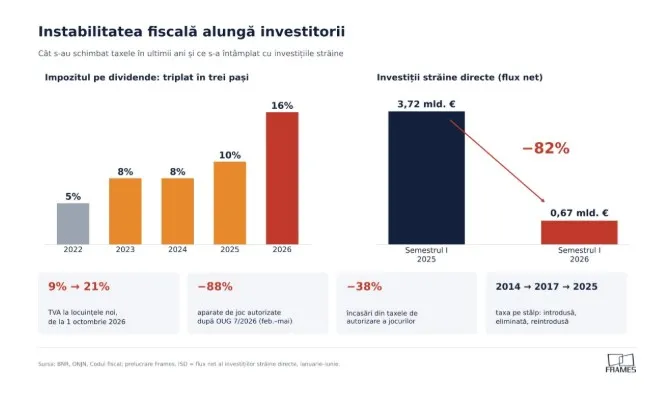
Economists Call for Stable Taxes Over 3–5 Years: Foreign Investment in Romania Has Dropped by 82%
21 October 2026
 Foto ilustrativă
Financial crisis in hospitals: funds left for only two more weeks, 8 billion RON needed
21 October 2026
 Foto ilustrativă
Food prices are rising again: economists warn about 2027 prices
19 October 2026

Beijing will become a "super-ageing" city by 2035
19 October 2026