
Robotic surgery for knee arthroplasty now available at SANADOR Clinical Hospital
When conservative treatments no longer yield results in severe gonarthrosis, doctors may recommend a knee prosthesis, and SANADOR now offers arthroplasty and revision assisted by the CORI robotic system.
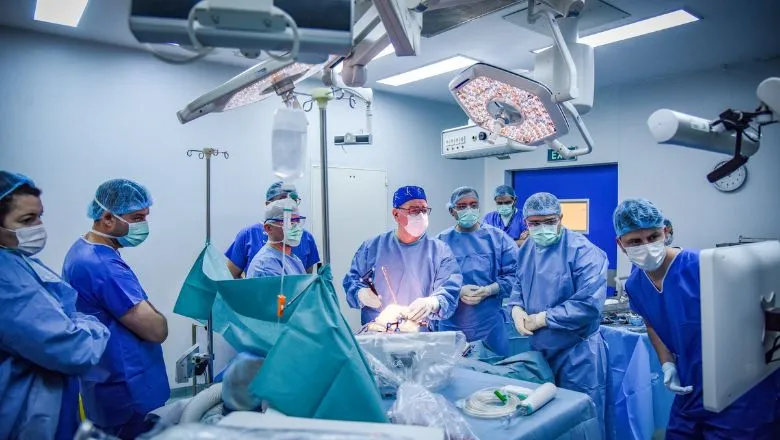
When gonarthrosis reaches an advanced stage and conventional treatments are no longer able to control the pain, joint stiffness, restricted movement, or even disability, an orthopaedic surgeon may determine that a partial or total knee replacement is needed to replace the damaged joint surfaces.
Orthopaedic surgery has advanced considerably, and knee arthroplasty is no longer viewed today as a simple joint replacement. It is a carefully planned procedure, tailored to each patient's individual anatomy — made possible by robotic systems used in orthopaedics. These technologies allow for a personalised approach and rigorous control over every key stage of the operation.
The role of the robot during the procedure
It is important to emphasise that the robot does not replace the surgeon — it supports them. The surgeon remains responsible for establishing the medical indication, the treatment plan, and every step of the operation, whilst the technology provides additional guidance for surgical precision.
Using the robotic system, the orthopaedic surgeon can create a three-dimensional model of the patient's knee and adapt the surgical plan to their specific anatomical characteristics. This allows for the optimal amount of bone and cartilage to be removed, whilst ligament balance is assessed during the procedure itself, ensuring the most appropriate positioning of the implant. The intended outcome is the correct fixation of the prosthesis in accordance with the established plan, which may contribute to better joint function, reduced pain, and a more effective post-operative recovery.
The final outcome of the procedure depends, however, on several factors: the patient's general state of health, the extent of joint damage, the experience of the surgical team, and how consistently the patient follows their post-operative rehabilitation programme.
When prosthesis revision is required
Robotic technology is not only used for primary knee arthroplasty, but also in more complex cases where revision of a previously implanted prosthesis is necessary. Revision may be recommended when the existing prosthesis is no longer functioning properly. In such cases, patients may experience persistent pain, knee instability, restricted movement, or other signs indicating a problem with the implant. Possible causes include component wear, loosening of the fixation, improper positioning of the prosthesis, or deterioration of the structures surrounding the joint — each situation requiring individual assessment.
Revision is generally a more complex procedure than primary arthroplasty. It may involve removing the existing components, restoring joint stability, managing bone loss, and selecting specialist implants tailored to each individual case. For this reason, careful planning and precision during the operation are essential.
In carefully selected cases, the robotic system can be of great assistance in knee prosthesis revision as well. It enables three-dimensional planning during the operation itself, giving the surgeon the ability to identify any positioning issues with the previous prosthesis, assess bone loss, adjust the surgical plan, and determine the most appropriate positions for the new components. The goal remains achieving the most accurate implant positioning and the best possible joint function, within the constraints of each individual case.
The decision to proceed with robotic arthroplasty or robotic knee revision is made only following a comprehensive orthopaedic assessment, which may include imaging investigations and a review of the patient's medical history. The surgical technique is determined on an individual basis, according to the specifics of each case.
Available at Spitalul Clinic SANADOR
At Spitalul Clinic SANADOR, patients with an indication for such a procedure have access to both robotic knee arthroplasty and robotic knee prosthesis revision, performed using the state-of-the-art CORI robotic system — introduced in Romania for the first time at this hospital. Depending on each individual case, the hospital also performs other types of robotic surgery for conditions within the fields of general surgery, urology, and gynaecology, using the da Vinci Xi robotic system. Procedures take place in a well-equipped operating theatre, under the care of experienced surgeons, with the support of specialists from the Category I Anaesthesia and Intensive Care Unit, with an extended level of competence.
Content paraphrased and adapted by SeniorHelp from verified public sources.
Original source: Digi24 →Previous article
Tibial Plateau Fracture After a Fall from a Ladder: How a 67-Year-Old Patient's Recovery Progressed
Next article
CDC warns: extreme heat can make common medications dangerous
Similar news

Microplastics in tap water can be reduced through boiling and filtering, a study shows
16 October 2026

Over 350,000 doses of flu vaccine to arrive in pharmacies next week
16 October 2026
First influenza-related death of this season confirmed by INSP: unvaccinated man from Cluj
16 October 2026

Partial Nephrectomy: The Operation That Treats Kidney Tumours and Preserves the Kidney
16 October 2026

Time spent in nature could improve one's relationship with food, a British study suggests
16 October 2026
What a liver operation involves: preparation and recovery
15 October 2026