
Severe Mitral Regurgitation Treated Minimally Invasively, Without Open-Heart Surgery
A 69-year-old man presenting with fatigue and breathing difficulties was diagnosed with severe mitral regurgitation and treated via a transcatheter procedure, without opening the sternum.
Vasile, aged 69, had been experiencing severe fatigue with minimal exertion for several years, to which a gradual difficulty breathing during everyday activities had been added, significantly affecting his quality of life.
The man had a complex medical history: obesity, dyslipidaemia, type 2 diabetes mellitus, arterial hypertension, and a previous myocardial infarction, following which a cardiac pacemaker had been implanted. Due to these associated conditions, his monitoring physician recommended a detailed cardiological assessment.
Investigations revealed that he was suffering from severe secondary mitral insufficiency. Echocardiography identified dilation of the mitral annulus and restricted movement of the valve leaflets, which prevented the valve from closing completely during cardiac contraction. The result was a backflow of blood from the left ventricle into the left atrium.
Although he urgently required treatment, his associated conditions and cardiovascular history ruled out the option of conventional open-heart surgery for Vasile. In search of a solution, he was referred to Prof. Dr. Horațiu Moldovan, a primary care cardiovascular surgery physician at SANADOR Clinical Hospital.
Taking into account the specific features of the case, the physician proposed a minimally invasive transcatheter mitral valve repair procedure. Prior to the procedure, Vasile underwent echocardiographic evaluation by Dr. Monica Trofin-Bănescu, primary care cardiologist and Head of the Cardiology Department, as well as coordinator of the Unit for Surveillance and Advanced Treatment of Critical Cardiac Patients (USTACC) within the hospital. The assessment confirmed severe mitral regurgitation and restricted mobility of the valve leaflets.
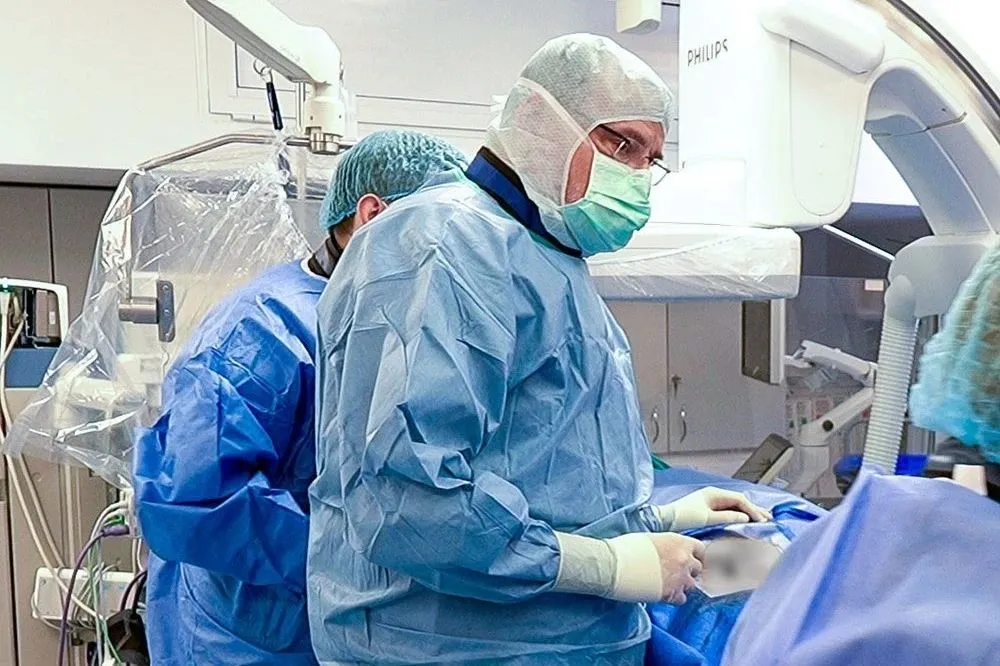
To repair the valve, Prof. Dr. Horațiu Moldovan implanted a PASCAL Ace device, which brought the mitral valve leaflets closer together and reduced regurgitation. The procedure was performed via an inguinal approach through the femoral vein, without stopping the heart and without opening the sternum.
The operation proceeded without complications, and the post-operative progress was favourable, allowing the patient to be discharged a few days after the procedure. A follow-up cardiac ultrasound confirmed the success of the intervention: mitral insufficiency had been significantly reduced, with only mild residual regurgitation remaining.
At SANADOR Clinical Hospital, patients with cardiovascular conditions benefit from a multidisciplinary assessment carried out by the Heart Team, to establish an accurate diagnosis and the most appropriate treatment for each individual case. The recommended interventional cardiology procedures are performed in the Catheterisation Laboratory, equipped with two Philips Azurion 7 angiography systems, or in the hybrid theatre of the fully digitalised operating suite. Complex cardiovascular surgery procedures are also carried out in the hospital's fully digitalised operating suite.
Content paraphrased and adapted by SeniorHelp from verified public sources.
Original source: Realitatea →Previous article
BNR explains why the euro has climbed to new all-time highs against the leu
Next article
Medicine shortages in pharmacies are not monitored in real time. Patients with serious illnesses at risk
Similar news
 Foto ilustrativă
GPs warn: flu vaccination should not be delayed
11 October 2026

GPs recommend flu vaccination before the epidemic spreads
11 October 2026

Depression in the elderly, mistaken for ageing: what signs to look out for
11 October 2026

Forgetfulness in Old Age: What's Normal and When to Visit PROMEMORIA for a Check-up
9 October 2026

Over 80,000 Respiratory Infections Recorded in Romania in One Week, INSP Data Shows
9 October 2026
 Foto ilustrativă
Raw milk can contain dangerous bacteria: who is at risk of severe illness
9 October 2026