
Daniel Dăianu: Romania risks recession in 2026 due to budgetary correction
The President of the Fiscal Council, Daniel Dăianu, warns that austerity measures could push Romania's economy into recession this year.
 Foto ilustrativă
Daniel Dăianu, President of the Fiscal Council, is warning that Romania could enter recession in 2026 as a result of the significant impact that budgetary correction is having on the economy.
According to an analysis published by Dăianu, reform of the unified pay system in the public sector is necessary and should be carried out as swiftly as possible, in order to eliminate existing inequities and to avoid sudden increases in public sector wages. In his view, a more predictable pay system would safeguard public finances and reduce additional pressure on the budget.
770 million euros lost, but not the primary cause of a potential derailment
The President of the Fiscal Council clarified that the loss of 770 million euros represents a cost to the budget; however, this sum, taken in isolation, would not be sufficient to trigger a major budgetary derailment. The statement comes amid political disputes surrounding the reform of the unified pay system and the manner in which public finances are being managed.
The role of European funds in 2026
Dăianu emphasises that European funds will play an important role in supporting the Romanian economy this year, even if the country does not succeed in fully absorbing the money available through the National Recovery and Resilience Plan (PNRR). Even if a portion of PNRR funds remains unabsorbed, European resources available through other programmes could contribute significantly to sustaining economic activity — a contribution all the more important given that budgetary adjustment measures are having a restrictive effect on the economy.
Recession risk, partially mitigated by European investment
The President of the Fiscal Council warns that the effects of fiscal consolidation could be strong enough to push Romania's economy into recession this year. In his view, support from European investments and financing can mitigate some of the impact of reduced public spending, whilst pay reform — alongside more prudent management of public finances — is essential if Romania is to avoid further economic imbalances.
Content paraphrased and adapted by SeniorHelp from verified public sources.
Original source: Realitatea →Previous article
More and more pensioners are taking out loans from the Employees' Credit Union just to make ends meet until the end of the month
Next article
The Fiscal Council calls for a gradual increase in the retirement age, amid the "decree generation" demographic wave
Similar news

Eurostat: Bucharest-Ilfov, third highest growth in the EU (33%), but South Muntenia and Oltenia fell by over 11%
23 October 2026
Romania, the Largest Budget Deficit in the EU in Q2 2026, Eurostat Data Shows
22 October 2026
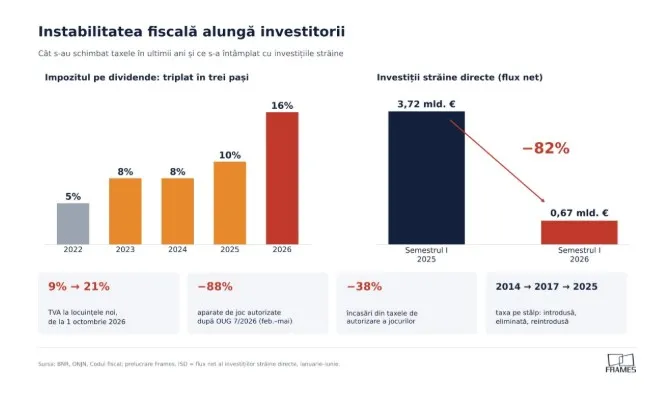
Economists Call for Stable Taxes Over 3–5 Years: Foreign Investment in Romania Has Dropped by 82%
21 October 2026
 Foto ilustrativă
Financial crisis in hospitals: funds left for only two more weeks, 8 billion RON needed
21 October 2026
 Foto ilustrativă
Food prices are rising again: economists warn about 2027 prices
19 October 2026

Beijing will become a "super-ageing" city by 2035
19 October 2026