
The Fiscal Council calls for a gradual increase in the retirement age, amid the "decree generation" demographic wave
The Fiscal Council recommends linking the retirement age to life expectancy and eliminating exceptions, against the backdrop of the approaching retirement of the "decree generation" and the growing deficit in the social insurance system.

The Fiscal Council recommends a gradual adjustment of the retirement age, linked to life expectancy, along with the elimination of exceptions to the standard retirement age threshold. These measures are proposed to ease pressure on the budget, in the context of an ageing population and the approaching retirement of the so-called "decree generation".
In its annual report for 2025, the institution warns that demographic trends represent one of the main risks to Romania's public finances. As the large generations born following the 1966 Decree reach retirement age, the number of beneficiaries will increase, whilst the contributor base remains limited.
"Against the backdrop of the 'decree generation' reaching retirement age, the cost of population ageing — partially factored into the baseline projection — is placing additional pressure on expenditure. According to this data, pension spending in Romania is projected to rise through to 2030," the report states.
The Fiscal Council notes that not the entire "decree generation" is retiring right now. Under the current schedule, the first large cohorts, born in 1967, will reach the standard retirement age from 2030 for women and from 2032 for men. Some individuals may leave the workforce earlier if they meet the conditions for early retirement or are entitled to statutory reductions.
What measures does the Fiscal Council recommend
To limit the budgetary impact of population ageing, the institution proposes increasing labour market participation, broadening the contribution base, and gradually adjusting the retirement age.
"Mitigating these risks would require a series of structural measures: increasing labour market participation, gradually adjusting the retirement age in line with life expectancy, and eliminating exceptions to the standard retirement age," the document states.
The report does not specify a new retirement age or a concrete timetable for implementing the measure. The recommendation simply involves linking the standard retirement age to life expectancy, whilst reducing the derogations that allow earlier exit from the workforce.
Demographic pressure is compounded by low labour market participation, at around 67% in Romania, compared with the European average of 75.3%. In 2025, the employment rate for those aged between 15 and 64 stood at 63%, a decrease of 0.8 percentage points compared with the previous year. Romania had the second-lowest employment rate in the EU, after Italy, with a gap of eight percentage points below the European average.
The social insurance system deficit has increased
The deficit of the state social insurance budget, including special and occupational pensions, reached 52.4 billion RON in 2025, some 12.7 billion RON more than the previous year. The combined deficit of the social insurance budgets — covering pensions, health, and unemployment — accounted for 27.8% of the total budgetary deficit.
The Fiscal Council notes that, although the general budgetary deficit narrowed by 1.4 percentage points of GDP in 2025, the deficit of the social insurance systems widened by 0.3 percentage points. Social assistance expenditure rose by approximately 12% in 2025, equivalent to nearly 27 billion RON, primarily due to the pension recalculation applied from September 2024, which is now being felt across the full year.
For 2026, social assistance expenditure is estimated at approximately 249 billion RON, equivalent to 12.2% of GDP, based on the freezing of public pensions, special pensions, social allowances, and child benefits at their December 2025 levels.
What the Fiscal Council says about pension indexation
For the 2027 budget, the Fiscal Council recommends that increases in pension and public sector wage expenditure be aligned with economic performance: "For 2027, projected public expenditure on wages and pensions must not, in terms of growth rate, exceed the rate of nominal GDP growth, and any indexation must be cautious."
The institution projects real economic growth of approximately 2% for 2027 and inflation that could fall below 4% by the end of the year, provided no additional shocks materialise. The budgetary deficit should be reduced to around 5.5% of GDP.
The Fiscal Council considers that wage increases and pension indexations have, until now, been discretionary in nature, and recommends transparent and predictable rules, linked to economic developments and purchasing power.
In 2025, expenditure on wages and social assistance, including pensions, accounted for 68.8% of Romania's budgetary revenues, a decrease of 4.2 percentage points compared with 2024, owing to fiscal consolidation measures. Pressure on public finances nonetheless remains high, particularly due to budgetary revenues that are lower than in other European states.
Content paraphrased and adapted by SeniorHelp from verified public sources.
Original source: Digi24 →Previous article
Daniel Dăianu: Romania risks recession in 2026 due to budgetary correction
Next article
Fiscal Council: mild recession possible in 2026, recovery estimated for 2027
Similar news

MyCNPP: the Pension House app that lets you check your contribution period and pension estimate
23 October 2026
A commune in Vrancea, with 3,700 inhabitants, has been looking for a dentist for 7 years
22 October 2026

Mayor of Craiova: Property taxes cannot be calculated at market value from 2027
22 October 2026
 Foto ilustrativă
BT Pensii reaches 300,000 participants and over 1 billion RON in assets
22 October 2026
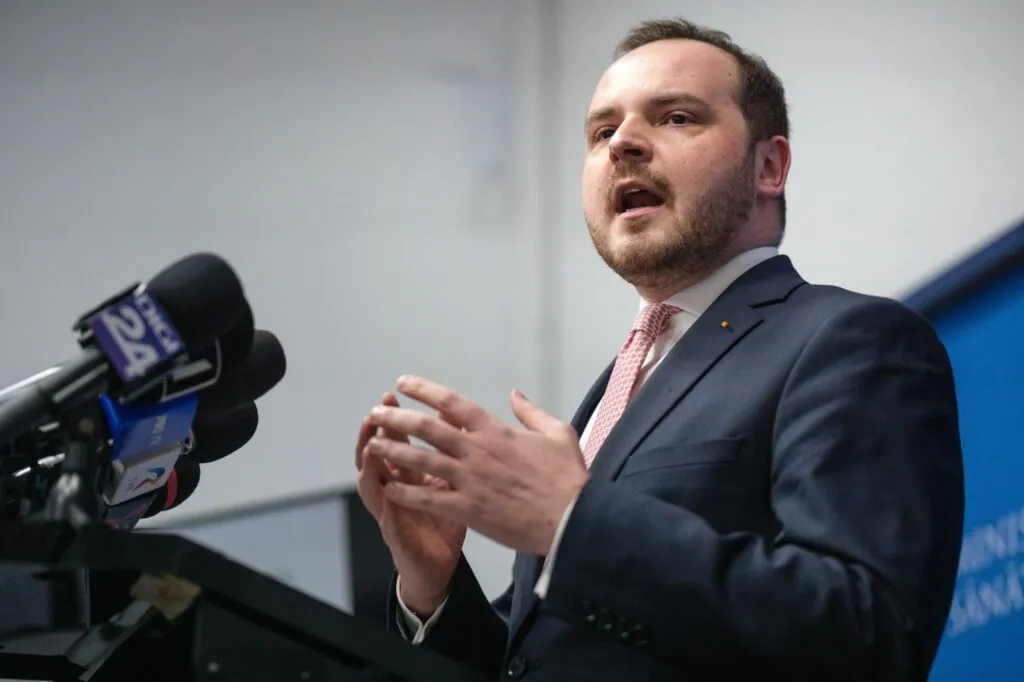
New Health Minister: Hospitals need over 10 billion RON, I will request funds from the reserve fund
21 October 2026
 Foto ilustrativă
Savings and Investment Accounts (CEI): what tax benefits does Law 202/2026 bring
21 October 2026