
The Bihor Case: how elderly care providers circumvent state oversight
Katia Cicală (PFPSS) explains to Mediafax why some private care homes for the elderly are moving into a "grey area" following the tightening of licensing requirements in 2024, thereby circumventing state inspections.
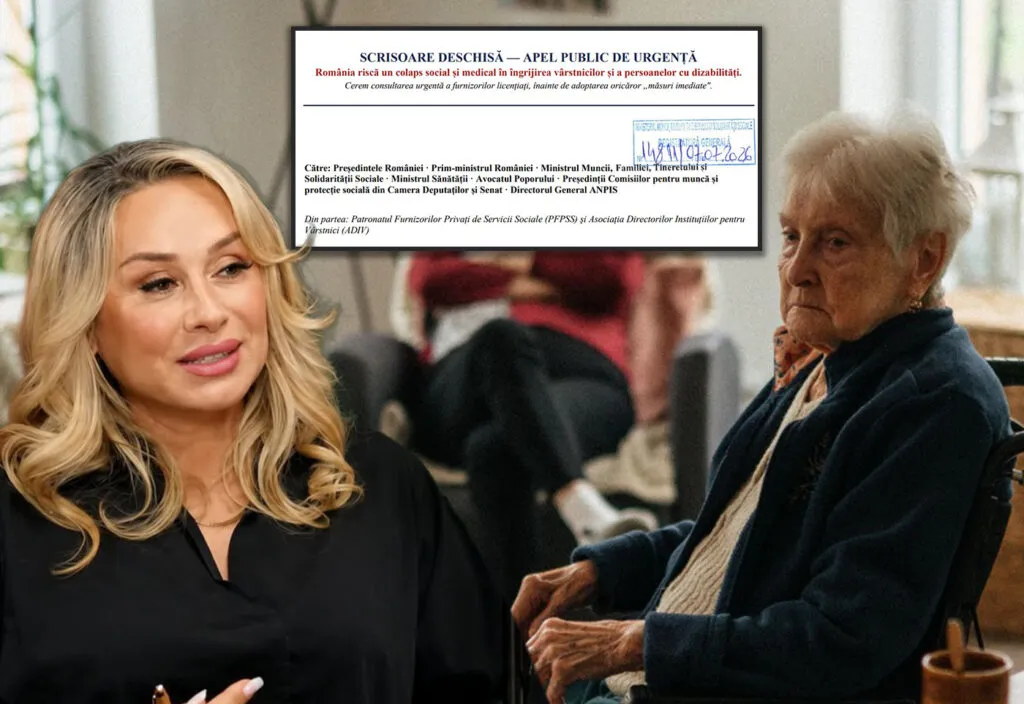
Legislation adopted in 2024 following the "horror care homes" scandal tightened the conditions for licensing social services by the Ministry of Labour. However, a recent case in Bihor shows that many private providers have chosen to circumvent these stricter rules by moving their operations into a "grey area", according to lawyer Katia Cicală, president of the Private Social Service Providers' Federation (PFPSS), in an exclusive interview with Mediafax.
According to an open letter sent to the state by the PFPSS and the Association of Directors of Institutions for the Elderly (ADIV), private centres operating as associations, foundations, or limited liability companies that were unable to obtain a licence due to the extreme conditions imposed sought alternative operating codes in order to continue their activities, despite already having residents in their care, some for years.
Katia Cicală explains: "There are former care homes that were unable to renew their licences due to the extreme conditions imposed. Since their premises were already operational and people were already living there and receiving these services — some of them for years — they were forced to seek other solutions. For example, code 8710 was replaced with 'residential medical care services', which we consider to be a legally valid operating code; however, there are contradictions between the Ministry of Labour and the Ministry of Health, because essentially the same activity of caring for elderly people is being carried out. All of these elderly individuals have serious health conditions and receive medical care on a daily basis."
Subletting accommodation — another option used by some providers
The president of the PFPSS says that some providers have resorted to subletting living space, combined with separate contracts for home medical care and catering. She maintains that this arrangement is lawful: "A person who rents a room is in their own home. They can therefore receive home medical care and have meals provided by a catering company. From a legal standpoint, it is perfectly legitimate."
Nevertheless, Cicală warns that under this type of arrangement, the Ministry of Labour is no longer able to carry out inspections regarding care conditions, as doing so would require "entering the home of every elderly person". She notes that in other countries, the concept of "assisted living communities" exists — blocks of flats or interconnected housing complexes where elderly people choose to live.
When asked about the case in Bihor, the president of the PFPSS stated that the federation "will never support illegal operations" and that "the law must be respected, as that is what it means to live in a state governed by the rule of law". She stresses, however, that the need for alternative solutions exists precisely because the elderly care system is at risk of collapse, as sector representatives had previously warned.
Private centres too costly for many elderly people
The minimum cost at which a private centre can operate legally is approximately 6,100 RON per month per resident. Elderly people with pensions below 6,000 RON who still have living relatives do not qualify for a place in a public centre, yet cannot afford a private one, whose fees exceed the value of their pension.
According to the joint letter from the PFPSS and ADIV, public care homes are reserved primarily for people with no income and no legal next of kin, and available places are fully occupied in any case, with waiting lists in place.
Proposal: classifying centres by comfort level and cost
In addition to simplifying the licensing procedure for elderly care centres, providers are also proposing a simplification of the classification system. Katia Cicală explains: "At present, the conditions require two or three beds per room, a large surface area per bed, and a very high number of staff, all of which significantly drives up costs. Under current standards, costs are enormous and people simply cannot afford them."
The PFPSS proposes classifying centres according to comfort level and number of beds per room, so as to allow more affordable rates: "A two-star, three-star, or five-star care home, with different standards for each tier. I know a great many people who desperately want to place their parents or grandparents in such a facility but cannot afford the fees."
The federation's president believes that if the state were to allow differentiated standards, families could choose a centre suited to their financial means: "Someone without money should be able to go somewhere and be cared for, because it is better to be looked after in a specialist centre than to die alone at home because one cannot afford a higher-cost facility."
There are currently around 700 private centres in Romania providing elderly care services. Katia Cicală argues that the current legislative framework must change: "If the licensing procedure were relaxed, all of these providers would return to the regulated system. We are making an appeal — and continue to do so — to the authorities, and particularly to the Ministry of Labour, to take our materials into consideration and to consult us on amending the legislation."
Content paraphrased and adapted by SeniorHelp from verified public sources.
Original source: Mediafax →Previous article
Pensions below 3,000 RON in some counties: major regional disparities across Romania
Next article
Nazare: almost half of the state funding for 2026 is already secured
Similar news

New law: savings and investment accounts for retirement, based on the American 401(k) model
16 October 2026

Pensions indexed from 2027 and capped salaries: what the Niculescu Government's programme provides for
15 October 2026

Niculescu Government promises extended energy bill support and gradual gas liberalisation
15 October 2026

AUR proposes retirement at 60 for people diagnosed with cancer
15 October 2026

College of Physicians calls for government reforms: on-call duties paid at 2017 salary levels
14 October 2026
 Foto ilustrativă
Patients with chronic illnesses warn they risk running out of treatments. Appeal to authorities
14 October 2026