
Sarcopenia in the Elderly: How to Recognise It and What Families Can Do
Muscle loss in older adults increases the risk of falls and dependency. Discover the signs of sarcopenia and how you can support your parents or grandparents in staying active.
Contents
When Maria's mother started saying that her "legs had grown weak" and that she could no longer open jars on her own, the family put it all down to old age. It was only at a visit to the geriatrician that they learned it was sarcopaenia — a progressive loss of muscle mass and strength that affects many older adults. The good news? When detected early, its progression can be significantly slowed through a tailored diet and exercise.
Sarcopaenia is not simply "old-age weakness" — it is a condition with serious consequences: falls, fractures, and loss of independence. Yet many families either fail to recognise it or believe nothing can be done. In reality, the family plays an essential role — from spotting early signs to providing the daily support that makes the difference between autonomy and dependence.
This article explains what sarcopaenia is, how you can spot it at home, and — most importantly — what concrete steps you can take to help your parent or grandparent maintain their muscle strength and quality of life.
Contents
- What sarcopaenia is and why it develops in older adults
- Signs that family members can observe at home
- The link between sarcopaenia, falls, and dependence
- The role of diet and exercise in slowing its progression
- How the family can support the older person
- When to seek a specialist geriatric assessment
- Frequently asked questions
What sarcopaenia is and why it develops in older adults
Sarcopaenia is the progressive loss of muscle mass, strength, and function that occurs with ageing. The term comes from the Greek words "sarx" (flesh) and "penia" (lack). It is not simply a matter of losing weight — an older person may look the same as before, yet beneath the surface their muscle mass is declining, sometimes being replaced by fatty tissue.
The process typically begins after the age of 40, but accelerates after 65–70. Studies show that approximately 10–16% of adults over 65 and over 50% of those over 80 are significantly affected. The causes are multiple and interconnected:
- Hormonal changes — declining levels of testosterone, oestrogen, and growth hormone reduce muscle protein synthesis
- Low-grade chronic inflammation — known as "inflamm-ageing", this accelerates muscle breakdown
- Reduced physical activity — a sedentary lifestyle leads to muscle atrophy through lack of stimulation
- Insufficient protein intake — many older adults eat less and tend to choose foods that are easier to chew but lower in protein
- Anabolic resistance — the muscles of older adults respond less effectively to growth stimuli than those of younger people
The difference between sarcopaenia and normal ageing
It is true that everyone loses some muscle mass with age. However, sarcopaenia goes beyond "normal" loss and impairs functional capacity — that is, the ability to move, care for oneself, and remain independent. This is precisely why early detection and intervention are so important.
Signs that family members can observe at home
Sarcopaenia develops gradually, and its signs can easily be overlooked or simply attributed to old age. Here is what you should watch for when spending time with or talking to your parent or grandparent:
- Fatigue when walking — walking becomes slower, they stop more often to catch their breath, and they avoid stairs or longer outings
- Difficulty lifting things — they can no longer carry a bag of shopping on their own, or struggle to get up from a low chair without holding on to something
- Visible muscle loss — the legs look thinner, trousers hang loosely, and the arms appear more frail
- Repeated falls or loss of balance — they stumble, lose their balance more easily, and lean on furniture more frequently
- Unexplained weight loss — a loss of 5% or more of body weight over 6–12 months, without dieting or acute illness
- Slowness in daily activities — getting dressed, showering, and preparing meals all take noticeably longer
A simple test you can do at home
The Timed Up and Go test is used by clinicians, but you can adapt it at home: time how long it takes the older person to rise from a chair with a back, walk 3 metres, turn around, and sit back down. If it takes more than 12 seconds, there is an increased risk of falls and it is worth discussing with a doctor.
Another simple indicator: if the calf circumference (measured at the widest point of the lower leg) is below 31 cm in men or below 30 cm in women, this may indicate sarcopaenia and warrants medical assessment.
The link between sarcopaenia, falls, and dependence
Why does it matter so much to recognise sarcopaenia early? Because it sets off a vicious cycle with serious consequences for an older person's health and independence.
Weakened muscles mean poor balance and slower reflexes — precisely the conditions that lead to falls. And a fall in an older person is never trivial. It can result in a hip fracture, which in turn forces prolonged immobility. Immobility accelerates muscle loss even further (an immobilised older person can lose up to 1% of their muscle mass per day), creating a downward spiral of functional decline.
Impact on quality of life
Beyond the medical implications, sarcopaenia profoundly affects quality of life. An older person who no longer has the strength to leave the house, go to the market, or play with their grandchildren becomes forced into isolation. Fear of falling sets in, leading to avoidance of activity — and consequently, even further muscle atrophy.
- Increased risk of hospitalisation and post-operative complications
- Loss of independence in daily activities (personal hygiene, dressing, eating)
- Need for full-time care or residential placement
- Declining self-esteem and increased risk of depression
The good news? Research shows that early intervention — even in frail older adults — can improve muscle strength and reduce the risk of falls and dependence. It is never too late to start.
The role of diet and exercise in slowing its progression
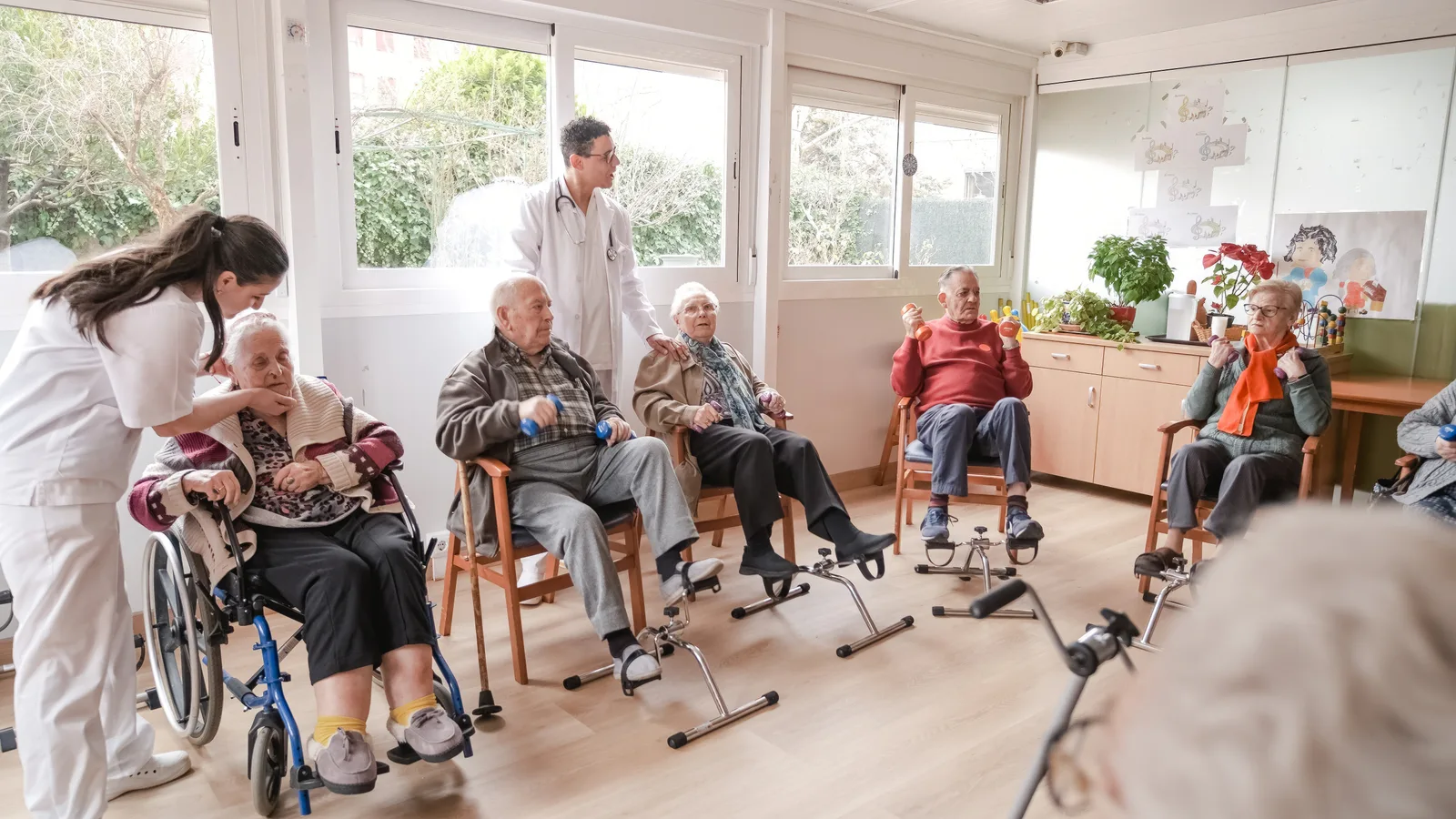
Sarcopaenia cannot be fully "cured", but its progression can be significantly slowed — and sometimes even partially reversed — through two main interventions: adequate protein intake and appropriate physical exercise.
A protein-rich diet
Older adults need more protein than younger adults to maintain muscle mass — around 1–1.2 grams of protein per kilogram of body weight per day, spread evenly across each meal. For a 70 kg adult, this means approximately 70–85 grams of protein daily.
- Complete protein sources: lean meats (chicken, turkey, beef), fish, eggs, dairy products (Greek yoghurt, cottage cheese, feta), and pulses combined with wholegrains
- Protein at every meal: 20–30 g of protein per meal (for example, 100 g of chicken breast or 2 eggs plus 150 g of yoghurt)
- Leucine — an essential amino acid that stimulates muscle synthesis, found in abundance in dairy products, meat, and eggs
- Vitamin D and calcium — essential for muscle and bone health
Many older adults eat less due to reduced appetite, dental problems, or difficulty preparing meals. This is where the family can step in: small, frequent meals, adapted textures (minced or puréed if needed), and shared mealtimes that help to stimulate appetite.
Adapted exercise — the key to maintaining strength
Physical exercise is just as important as diet. Muscles need constant stimulation to prevent atrophy. Research shows that even adults over 80 can gain muscle strength through appropriate training.
- Resistance exercises — using resistance bands, light weights, or bodyweight (2–3 sessions per week)
- Balance exercises — standing on one leg, heel-to-toe walking, Tai Chi
- Daily walking — a minimum of 20–30 minutes at a moderate pace
- Stretching and flexibility work — to maintain joint mobility
Important: Before beginning any exercise programme, consult a geriatrician and, ideally, a physiotherapist specialising in geriatrics. They will tailor the exercises to the person's current capacity and any associated conditions (osteoarthritis, heart problems, etc.), and will ensure safe progression. An ill-suited programme can do more harm than good.
How the family can support the older person
Family members do not need to be physiotherapists or nutritionists to make an enormous difference in the life of an older person with sarcopaenia. Consistent, everyday support is often more important than occasional interventions.
Adapting the home for safety and independence
A safe environment reduces the fear of falling and encourages movement:
- Remove slippery rugs and hazardous thresholds
- Install grab rails in the bathroom and beside the toilet
- Ensure good lighting throughout the home, including in hallways at night
- Keep walkways clear of furniture that obstructs normal routes through the home
- Use a stable shower chair and a non-slip mat in the bath
- Keep everyday items within easy reach, without needing to climb stairs
A daily routine that supports strength
Encourage physical activity every day, even in the form of everyday household tasks:
- Short walks after meals — accompany them, or find a neighbour of a similar age for company
- Involvement in light household tasks (preparing meals, tending to plants, folding clothes)
- Simple exercises during television adverts or in the morning after waking up
- Social activities that involve movement: dancing, walks in the park, visiting friends
Emotional and motivational support
Changing habits at the age of 70 or 80 is not easy. Older adults may feel frustrated by their limitations or believe that "it doesn't matter any more". Empathy and consistent encouragement make all the difference:
- Acknowledge small victories — "You walked further today than you did last week!"
- Do not criticise weakness; instead, celebrate effort
- Be present without taking over — let them do what they can, even if it takes longer
- Talk openly about fears and find solutions together
When to seek a specialist geriatric assessment
Not every sign of muscle weakness requires urgent medical attention, but there are moments when specialist assessment is essential. Here is when you should consult a geriatrician:
- Rapid weight loss — more than 5% of body weight within 6 months, without dieting or obvious illness
- Repeated falls — more than two falls in the past 6 months, or a single fall resulting in injury
- Major difficulties with daily activities — they can no longer manage personal hygiene, dressing, or meal preparation independently
- Marked muscle weakness — unable to rise from a chair without assistance, or to walk more than a few steps
- Recent hospitalisation — following prolonged immobility, the risk of accelerated sarcopaenia is significantly increased
What a geriatric assessment involves
The geriatrician will carry out a comprehensive assessment of the older person's condition using functional tests (grip strength, walking speed, Timed Up and Go), anthropometric measurements, and, where necessary, additional investigations (DXA scanning for body composition, blood tests for nutritional deficiencies and hormone levels).
Based on this assessment, a personalised plan can be put in place, which may include:
- An adapted physiotherapy programme, initially supervised
- A nutritional consultation and specific dietary plan
- Supplements (vitamin D, protein, and possibly creatine — only on medical advice)
- Treatment for associated conditions that worsen sarcopaenia (diabetes, heart disease, anaemia)
- Recommendations for adapting the home environment and daily activities
Regular reassessment (every 6–12 months) allows progress to be monitored and interventions to be adjusted accordingly.
Frequently asked questions
At what age does sarcopaenia begin, and can it be prevented?
Muscle loss begins subtly after the age of 40, but accelerates after 65–70. Yes, it can be prevented or slowed through regular physical activity (particularly resistance training) and a protein-rich diet throughout life. It is never too early or too late to start.
Do older adults need protein supplements?
Not always. Ideally, protein should come from whole foods. However, if appetite is poor or there are difficulties with chewing and swallowing, protein supplements (powders, drinks) can help in meeting daily requirements. Speak to a doctor or nutritionist before starting any supplementation.
Is weight training safe for older adults?
Yes, when properly adapted and initially supervised by a specialist. Studies show that even adults over 80 can safely perform resistance exercises and gain muscle strength. The key is to start gradually, using light weights or resistance bands, under the guidance of a physiotherapist.
Is sarcopaenia treated with medication?
There is currently no approved medication specifically for sarcopaenia. Research is ongoing, but the validated interventions remain physical exercise and adequate nutrition. A doctor can treat associated conditions that worsen sarcopaenia (hormonal deficiencies, chronic inflammation, malnutrition).
How quickly can improvement be seen?
With a consistent programme of exercise and proper nutrition, initial improvements in strength typically appear within 6–8 weeks, and increases in muscle mass become measurable after 3–6 months. The important thing is to be patient and consistent — progress is slower than in younger people, but it is real and meaningful.
If my parent refuses to exercise, what can I do?
Try to incorporate movement into enjoyable activities: walks in the park with grandchildren, dancing to favourite music, light gardening, or interactive games. Avoid imposing, and instead offer options and lead by example. Sometimes, a recommendation from a doctor or physiotherapist carries more weight than advice from family.
Sarcopaenia is not a "sentence" to dependence, but a challenge that can be met with understanding, patience, and consistent action. Every step your older relative takes today — whether it is a short walk or an extra egg at breakfast — is an investment in their independence and quality of life tomorrow. If you notice the signs described in this article, do not wait: speak to your GP or request a geriatric assessment. Working together, family and medical teams can make the difference between dependence and an active, dignified older age.
This article is intended for informational purposes only and does not replace medical advice. Please consult a specialist for your specific situation.
Previous
Atrial Fibrillation in the Elderly: A Family Guide to Symptoms and Care
Next
Chronic Renal Failure in the Elderly: Symptoms, Diet and Care
Similar articles

Sprijinul familiei în prevenirea escarelor la domiciliu
20 October 2026
How to Manage Inappropriate Sexual Behaviour in Elderly People with Dementia
20 October 2026

Nocturnal Hypoglycaemia in the Elderly: How to Recognise It and What Families Can Do
19 October 2026
Flu in the Elderly: When It Becomes Serious, How to Prevent It and What Families Can Do
17 October 2026
Polypharmacy in the Elderly: What Families Need to Know
16 October 2026
Caregiver Burnout: Signs to Recognise and How to Ask for Help
15 October 2026