
Medical robot restores mobility to patient with complex knee prosthesis
A 66-year-old man, having undergone three failed knee surgeries, received Romania's first robotic revision arthroplasty at SANADOR, using the CORI system.
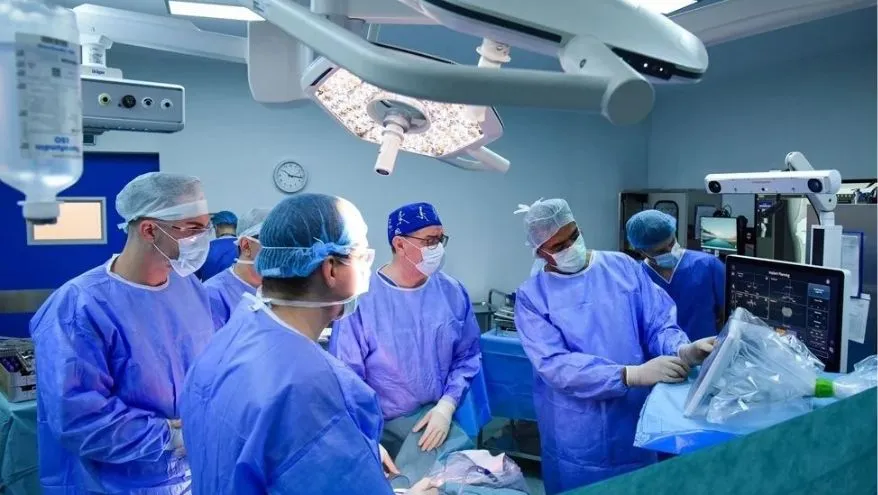
Cristian, aged 66, had long been suffering from severe pain and very limited mobility in his left knee, to the point where he could no longer put on his own shoes. The problems stemmed from a motorcycle accident that had occurred five years earlier.
By the time a solution was found, he had already undergone three knee surgeries. The first was an arthroscopy to treat the injuries caused by the accident, followed by the implantation of a knee prosthesis, which became necessary due to severe cartilage deterioration. Over time, the joint's mobility declined once again, requiring a second arthroscopy — this time to remove the adhesions that had formed. However, this operation too brought only short-lived improvement.
Diagnosis at SANADOR
Cristian eventually came under the care of Dr. Liviu Ojoga, Head of the Orthopaedics and Traumatology Department at Spitalul Clinic SANADOR. Following a thorough assessment, the doctor established that the patient could only bend his knee to 40 degrees, with an extension deficit of minus 15 degrees.
X-rays showed that the prosthesis was well fixed, but had minor implantation defects: the joint line was elevated, and the patella was positioned lower than normal. Additionally, the fibrous tissue that had developed following the previous operations was further restricting the joint's movement. In light of this, the doctor recommended a further surgical intervention.
The case was made all the more challenging by the fact that Cristian also suffered from diabetes with polyneuropathy, obesity, arterial hypertension, dyslipidaemia, and cardiovascular disease, with a previous myocardial infarction in his medical history.
Romania's First Robotic Revision Arthroplasty
The patient consented to the operation and underwent, at Spitalul Clinic SANADOR, the first robotic revision knee arthroplasty ever performed in Romania, using the CORI robotic system, under spinal anaesthesia.
A revision arthroplasty involves replacing existing implants and reconstructing a joint that has previously been operated on. The CORI system does not perform the operation autonomously — instead, it builds a three-dimensional model of the joint during the procedure itself, with no need for a CT scan or MRI dedicated to pre-operative planning. The surgeon thus receives real-time data to assist with the precise positioning of the new implants and to preserve as much of the patient's healthy bone as possible.
During the operation, the surgical team removed the old prosthesis and scar tissue, reconstructed the joint line, fitted the new components with additional fixation, and also resurfaced the patella, with particular attention paid to knee stability and bone preservation.
Recovery
Cristian's post-operative progress was good, and he was discharged three days after the procedure. He was given guidance on gradual mobilisation, temporary use of an orthosis, rehabilitation exercises, and attendance at scheduled follow-up appointments.
In under three weeks, the patient was able to fully extend his knee and bend it to 94–95 degrees, and was once again able to put on his own shoes and care for his foot. By six weeks after the operation, his condition had improved further, as a result of his strict adherence to the rehabilitation programme, which was based on passive mobilisation and muscle-strengthening exercises.
About SANADOR's Services
At Spitalul Clinic SANADOR, patients with knee conditions have access to specialist consultations and all the investigations required to establish an accurate diagnosis and a treatment plan tailored to each individual case. Where surgical intervention is indicated, procedures can be performed using robotic surgery in orthopaedics, subject to medical recommendation.
The CORI robotic system can be used for both primary knee arthroplasty and revision of an existing knee prosthesis. All interventions are supported by the Category I Anaesthesia and Intensive Care Department, with an extended level of competence, within one of the best-equipped operating theatres in Romania.
Content paraphrased and adapted by SeniorHelp from verified public sources.
Original source: Digi24 →Previous article
BNR: Inflation Has Risen to 6.94% and Will Continue to Increase. Warning Regarding Pensions and Salaries in 2027
Next article
Pensioners' representatives consider the 7% pension indexation insufficient
Similar news

Ministry of Health proposes dispensing multiple sclerosis treatments through community pharmacies
17 November 2026

Alzheimer may show its first signs outside the brain, at the level of the muscles
17 November 2026

WHO warns: antibiotic resistance could cause 39 million deaths by 2050
16 November 2026

What Not to Do When You Wake Up at Night: The Mistake That Keeps You Awake
16 November 2026

Why the Risk of Stroke Increases in the Morning: Doctors Explain the Mechanism and How We Can Protect Ourselves
16 November 2026

Why autumn fatigue occurs: how shorter daylight hours affect sleep and energy
15 November 2026