CNAS has launched an application with data on beds, doctors and patients from any public hospital
CNAS has launched the platform cnas.ro/spitale, where you can view the bed occupancy rate, the number of doctors and patients at any public hospital in the country.
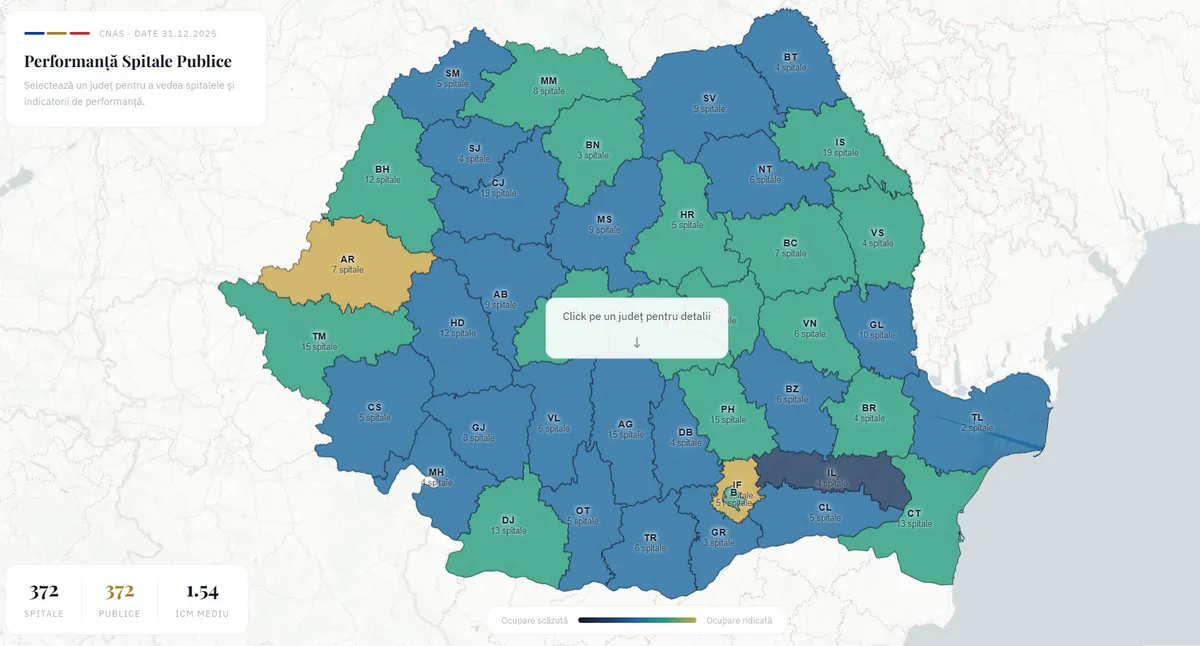
The National Health Insurance House (CNAS) has launched an application through which anyone can find information about every public hospital in Romania, including bed occupancy rates, number of patients treated, medical staff, and other activity indicators. The platform brings together data that was previously difficult to find or scattered across multiple sources.
The application is freely accessible on the CNAS website at cnas.ro/spitale, and covers all public hospitals that have a contract with the health insurance system.
How to use the application
The interface is organised by county. The user selects the county of interest – for example Olt, Cluj, Iași, or București – and the system displays a list of public hospitals in the area, along with the number of beds and the occupancy rate for each facility, allowing hospitals to be compared at a glance.
Once a specific hospital is selected, its page displays detailed information: the number of beds set out in the approved structure, the occupancy rate, the number of patients treated in 2025, available staff (including the number of doctors and nurses), and the complexity of cases treated.
Each page also includes the number of patients discharged in 2025, the average length of stay, and other indicators relating to activity and resource use. The application also allows hospitals with a similar profile from different counties to be compared.
What the CNAS President has to say
The President of CNAS, Horațiu Moldovan, stated in an official press release: "Today we are launching an application that provides, for the first time, a clear overall picture of how Romania's hospital system operates. With it, anyone can view essential indicators of hospital activity: how many patients are treated, how long the average hospital stay lasts, how beds are being used, how resources are being utilised, and how each hospital compares with similar facilities across the country. This is information that, until now, was difficult to access or dispersed across multiple sources."
He noted that the platform's purpose is to ensure that decisions about the organisation and funding of the healthcare system are based on concrete data rather than perceptions: "I firmly believe that in healthcare we can achieve better results with the resources we have, if we use them more efficiently. Data shows us where the system is working well and where change is needed. Without data, reform is based on perceptions. With data, reform is based on evidence."
What the data reveals about Romania's hospitals
According to information presented by Horațiu Moldovan, the average bed occupancy rate for acute care patients is approximately 63%, meaning that, on average, one in three contracted beds remains unoccupied. More than 140 hospitals have an occupancy rate below 60%, and in 63 facilities it falls below 50%. At the same time, large emergency hospitals are frequently overcrowded.
"The issue is not the total number of beds. We have sufficient beds at a national level, but their distribution reflects, in many cases, a demographic and epidemiological reality that has changed significantly in recent years. The structure of expenditure must be carefully analysed," explained the CNAS President.
The data also shows that in half of all hospitals, staff costs exceed 79% of the income received from health insurance funds, and in dozens of hospitals this figure surpasses 90%.
"This is not a criticism of hospital management, but rather a signal that the organisation and funding of the hospital network must be adapted to current realities, so that sufficient resources remain available for medicines, medical supplies, and investment," Horațiu Moldovan added.
Content paraphrased and adapted by SeniorHelp from verified public sources.
Original source: Digi24 →