
COPD, the lung disease that progresses "in silence": 1 in 10 Romanians could be affected
Approximately 8.4% of Romanians are estimated to have COPD, a disease that irreversibly destroys the lungs. Spirometry, a free and quick test, can detect the condition at an early stage.
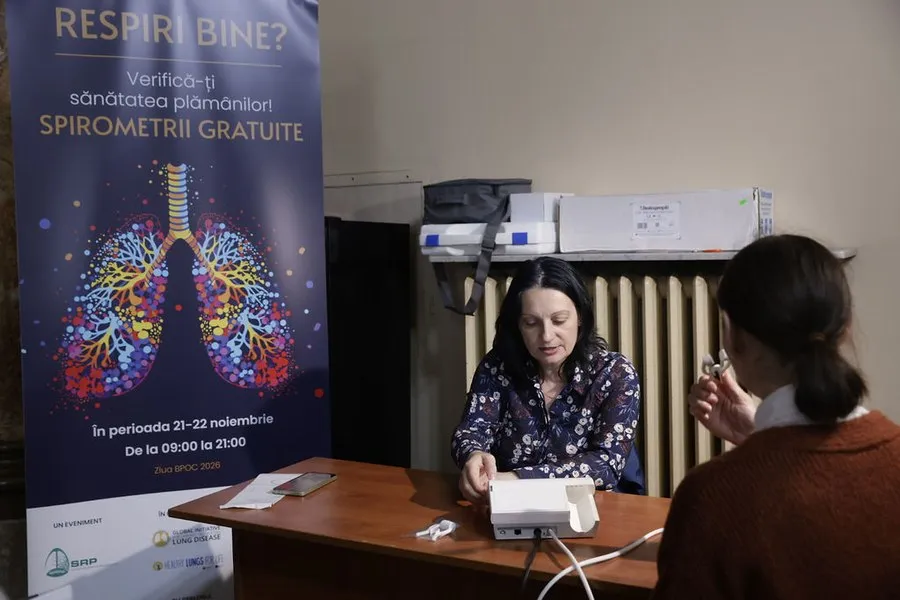
Persistent coughing, unusual fatigue on exertion, and a feeling of breathlessness are often attributed to age, smoking, or lack of physical activity. In reality, these signs may conceal chronic obstructive pulmonary disease (COPD), a lung condition that can progress for years without being detected.
According to medical professionals, COPD affects hundreds of millions of people worldwide, and in Romania, based on national surveys cited by specialists, prevalence is estimated at approximately 8.4% of the tested population – meaning that roughly one in ten Romanians may have the condition. The concerning news is that by the time a patient notices they are breathing with increasing difficulty, some of the lung damage may already be irreversible.
The Romanian Society of Pneumology is organising a free respiratory assessment campaign on 21 and 22 November, in Bucharest and Timișoara. The theme set for 2026 by the Global Initiative for Chronic Obstructive Lung Disease (GOLD) is "Early Diagnosis for a Better Life".
A condition that is difficult to recognise in time
COPD is a chronic, preventable, and treatable lung condition that restricts airflow through the airways. It develops gradually and may include chronic bronchitis and emphysema. Common symptoms include breathlessness, persistent cough, and ongoing sputum production.
Globally, according to the World Health Organisation fact sheet updated on 10 June 2026, COPD causes approximately 3.4 million deaths annually and is the third leading cause of mortality worldwide. Data presented at the conference dedicated to World COPD Day show that approximately 480 million people are living with the condition.
"COPD does not appear overnight, and the first signs are often ignored or attributed to age, smoking, or poor physical fitness. A persistent cough, fatigue on exertion, or the feeling that we cannot get enough air should not be considered normal. Early diagnosis matters: the sooner we identify the disease, the more effectively we can intervene to slow its progression and preserve the patient's quality of life," said Prof. Dr. Florin Mihălțan, President of the Romanian Society of Pneumology.
"The lung suffers in silence"
One of the reasons COPD is detected late relates to how the disease progresses: unlike other conditions that cause obvious pain, lung deterioration sets in slowly, without a clear signal for the patient.
"The lung does not signal distress – it suffers in silence. We do not have pain receptors there; pathologies grow and develop unnoticed," explained Prof. Dr. Cristian Oancea, Vice-President of the Romanian Society of Pneumology. Patients often adapt without realising it: they walk more slowly, avoid stairs, give up long walks, or take more frequent breaks, organising their lives around the activities they can still manage without feeling breathless.
Dr. Mihălțan explained that patients "consider the disease insignificant or mild, do not recognise the symptoms, and adapt their breathing to levels of exertion that allow them not to notice it".
Dr. Oancea provided a concrete example from an assessment carried out at a general practice in Timișoara: patients over 40 years of age with chronic bronchitis or morning cough associated with smoking were tested, and the results showed that 44% of them already had COPD without knowing it, with approximately 20% of those identified presenting moderate or severe forms.
Smoking and other risk factors
Smoking remains the primary risk factor for COPD. In Romania, data presented at the conference indicate approximately 34% of smokers, equating to 6.5 million adults who use tobacco. Of particular concern, among 15–16-year-old adolescents, 25–30% are reported to smoke conventional cigarettes, with some combining conventional smoking with e-cigarettes or heated tobacco products.
Specialists emphasise that no form of smoking is without risk to the lungs – neither e-cigarettes nor heated tobacco products are harmless. Dr. Oancea highlighted that quitting smoking remains essential even after diagnosis: according to data he presented, approximately 40% of diagnosed patients receiving treatment continue to smoke, despite the fact that exposure to smoke worsens the disease and reduces the effectiveness of treatment.
COPD can also arise from prolonged exposure to pollution, smoke, dust, or harmful substances in the workplace, as well as from genetic factors. Doctors also discussed the impact of urban pollution, traffic emissions, and indoor air pollution, including that caused by burning materials or waste.
A loss of five to seven years of life
COPD can be treated and managed, but lung deterioration is not always reversible. In emphysema, the pulmonary structures involved in gas exchange are destroyed, and the body cannot repair them.
"The lung, the pulmonary alveolus, is not like the liver – it does not regenerate. Once destroyed, it remains destroyed," warned Dr. Oancea. According to him, diagnosis can be delayed by between six and ten years, during which time patients may continue to smoke or be exposed to other harmful factors, unaware that their respiratory function is deteriorating.
In severe and very severe forms, the consequences can profoundly affect a patient's independence and quality of life. Doctors noted that patients with advanced forms may lose between five and seven years of life as a result of the disease, with some becoming dependent on oxygen concentrators and severely limiting their mobility.
The impact of COPD extends beyond the lungs: the disease can be accompanied by hypertension, diabetes, osteoporosis, muscle mass loss, depression, anxiety, and heart failure, and there is also a significant association with lung cancer.
"The impact of COPD goes beyond the lungs. Cardiovascular disease, lung cancer, and other associated conditions can complicate a patient's progression and increase the risk of death. For this reason, we must look beyond respiratory symptoms and assess the patient's health as a whole. Early diagnosis, smoking cessation, and treatment tailored to each individual are essential for preventing deterioration and preserving autonomy and quality of life for as long as possible," explained Dr. Oancea.
A simple cold can worsen the disease
For a patient with COPD, a common respiratory infection can trigger an exacerbation – a sudden worsening of symptoms that may require additional treatment or even hospitalisation. Prof. Dr. Roxana Maria Nemeș, former President of the Romanian Society of Pneumology (2020–2024), drew attention to the fact that after an exacerbation, lung function does not always return to its previous level, and repeated episodes can progressively worsen the patient's condition.
Exacerbations can affect the entire body: cardiovascular risk increases, and within the first 30 days following an exacerbation, complications such as myocardial infarction or heart failure may occur.
Another concerning aspect is the low vaccination rate among COPD patients: only approximately 4–5% are vaccinated against pneumococcus, and influenza vaccination coverage reaches at most 18%.
Spirometry – the few-minute test that could save years of life
Spirometry is a straightforward investigation that measures how much air a person can inhale and exhale, and how quickly they can expel it from their lungs. It is essential for confirming a COPD diagnosis and assessing lung function.
"Spirometry is the simplest, non-invasive, painless, quick, and accessible test for evaluating lung function and detecting COPD early. An ordinary cold that worsens breathing difficulties should not be ignored. Many lung diseases progress silently for years, and spirometry can identify airway narrowing before symptoms become severe," explained Prof. Dr. Roxana Nemeș.
The investigation is recommended for smokers, individuals exposed to occupational hazards, and those with chronic cough, wheezing, or fatigue on exertion. According to the doctor, "spirometry can be carried out free of charge, with a referral from a general practitioner, for a consultation with a specialist respiratory physician".
Content paraphrased and adapted by SeniorHelp from verified public sources.
Original source: Adevărul →Previous article
Negrescu: The New EU Budget Proposed by Costa, a Major Risk for Romania's Finances
Next article
Romanian Police: urban pensioners with secondary education are the main victims of online investment fraud
Similar news

Healthy, quick meals: how to cut out ultra-processed foods without spending hours in the kitchen
22 November 2026
Over 570,000 new doses of flu vaccine arriving in pharmacies
22 November 2026

19-year study: afternoon napping linked to risk of death in older adults
22 November 2026
HPV Vaccination: Romania Among Europe's Laggards, Despite Its Role in Preventing Cervical Cancer
22 November 2026

The 1-minute walking test that reveals how "aged" your brain is
21 November 2026
 Foto ilustrativă
Insulin Resistance or Prediabetes? A Doctor Explains the Differences and Required Tests
21 November 2026